
Tag Archives: gov20

The Week of Gov 2.0 – Longing for More

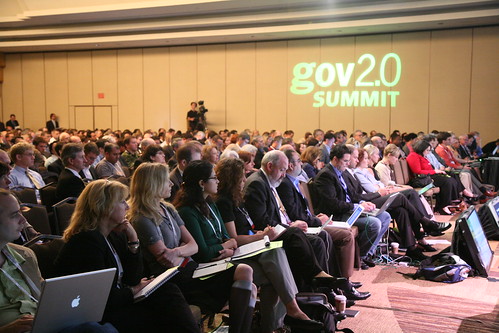
Image Courtesy of Flickr User Alex Dunne

Image Courtesy of Flickr User Alex Dunne

We’ve already had the Summer of Gov, but September 7-11 was the Week of Gov.  With the Gov 2.0 Expo Showcase on Tuesday and the Gov 2.0 Summit on Wednesday and Thursday, plus a multitude of happy hours and networking receptions, I was immersed in all things Gov 2.0 last week.  There are already plenty of recaps, summaries, and other articles detailing the events of last week – if you’re interested in finding out what you missed, videos from all of the sessions are (or will soon be) posted here.  Watch those, and then read through all of the news coverage here for that.  Now, what I want to explore in this post is one particular topic that came up time and time again among the attendees I spoke with.

There were some very successful, very cool Gov 2.0 initiatives that were highlighted, but while I came away both impressed and inspired by the results that were discussed, I was left asking myself more and more questions about HOW the speakers got to these results.  This isn’t a criticism of these two events – I realize that I wasn’t the target audience for the Summit (that program was geared more toward C-level execs) and the Showcase was more of a teaser for the Gov 2.0 Expo coming up in May.  That’s exactly why I now have more questions than answers – I want to know about the challenges these people faced; I want to know the risks they took and why; I want to know what they’d do differently if they could go back in time – most of all, I want to know how they went from good idea to being highlighted at the Gov 2.0 Expo Showcase or Gov 2.0 Summit.

As my colleague Brian Drake discussed in this blog post, we both spoke with a number of people who would like to see a  Gov 2.0 Practitioner event that targets the people actually doing the work of Government 2.0.  While it’s great to hear from people like Vivek Kundra and Vint Cerf, it’s difficult for me to relate directly to their experiences or to turn that knowledge into something actionable in my day-to-day job.  A Gov 2.0 Practitioner conference that focuses on the real-life challenges, benefits, and concrete actions would help fill this gap, giving attendees a action plan for moving forward.  So while I left the Gov 2.0 Summit feeling excited about the prospects of OpenID and Government 2.0, I was also left asking myself things like, “that’s great that OpenID is coming to the government, but now what?  How do I help my client’s organization take advantage of this program?  How do I turn this great idea into something actionable for my client?”

I think there’s a very real need for an event that brings together Gov 2.0 practitioners and aspiring practitioners in one place to share war stories, to discuss what really works and what doesn’t, and to learn from each others’ mistakes and successes.  Maybe it’s another Gov 2.0 Barcamp or another event entirely, but I don’t need another event to discover the benefits of opening up my data or by communicating more transparently.  What I need is an event that tells me how I get my manager to sign off on dedicating the resources needed to make that data open and accessible. I need an event that answers these questions  (and more):

  • How do I negotiate with my IT staff to get social media sites unblocked?
  • How do I involve our Legal department when I’m terrified they’re going to shut me down?
  • What’s the best way to get people to contribute to our organizational wiki?
  • What am I missing in my social media policy?
  • How do I best get senior leadership to actively participate in social media?  Should they?
  • We still have Internet Explorer 6 – how am I supposed to get IT to support social media?
  • We have a blog, Twitter account, podcasts, and other social media already, but no one is using them – what’s the best way to build more community?
  • We have a TON of data that I want to open up to the public, but I don’t own any of it – how do I approach the owners of this data and convince them to open it up?

Would you be interested in an event dedicated to sharing these types of war stories and providing actionable next steps that you could use?  If you’ve ever left a Gov 2.0 conference and had any of these questions, then you’re the target audience!

Continue reading...

What Does Government 2.0 Mean to Me?

Because Booz Allen is a Diamond Sponsor of next week’s Gov 2.0 Summit, and I’m on the Program Committee for the Gov 2.0 Expo Showcase, I have been incredibly busy trying to pull together presentations, talking points, attendee lists, and other logistics for next week.  However, I did take some time to participate in Tim O’Reilly’s “What Does Gov 2.0 Mean to You?” initiative in advance of the Summit next week.  For me, Government 2.0 isn’t about the tools, but what those tools enable – it’s about more than just creating a blog and engaging in dialogue with the public, it’s about more than just creating a wiki that’s open to multiple government agencies, and it’s about more than just making data accessible to the public.  Gov 2.0 is about what you do after that.  It’s about updating policies because of the conversations you had on the blog, it’s about using a wiki to deliver better intelligence analysis to our country’s decision makers, and it’s about opening up government data to crowdsource IT development, saving money increasing innovation.

There are tons of GREAT initiatives out there, initiatives that we’ll learn more about next week, but in many cases, these initiatives are just laying the foundation for government innovation. Think about it.  Next week, we will hear about lots of exciting Gov 2.0 initiatives taking place at the federal, state, and local levels. But, we’re also going to hear lots of stories about social media bans, offices still using IE 6, and information silos.  Remember that Government 2.0 isn’t just about getting on Twitter or building a wiki – those are just first steps.  It’s about using these tools to create a government that’s truly of the people, by the people, and for the people.

Continue reading...

Tired of All-Hands Meetings? Try an INTERNAL Unconference

On July 9th, 2009, my Strategic Communications team here at Booz Allen held an unconference as an alternative to the traditional All-Hands meeting.  Big thanks go out to Chris Hemrick, who led the planning, development, and execution of this event.  In collaboration with Chris and a few other team members, we pitched the idea to our leadership as a low-cost, low-resource opportunity to network, collaborate on some of the tough issues facing our team, learn from other members of the team, and have an opportunity to get involved with the rest of the team beyond their individual project teams.

So, how did we do it?  And more importantly, was it successful?

Pre-Conference

After receiving approval to move forward, we established our “home base” – a wiki page on our Enterprise 2.0 platform – hello.bah.com.  From here, we coordinated all our planning and outreach efforts.  We established the hashtag that we would use when blogging or Yammering about the Uconference.  We also determined the agenda for the day: 4:30 – 8:30 on a Thursday night with three sets of two concurrent sessions followed by one full wrap-up session and some networking time.  Sessions were to be restricted to one slide, and session leaders were only given 5 minutes to give the topic introduction.

About a month before the Unconference, we sent an email out to the team asking for people to propose potential topics via the wiki.  Sessions were then voted on by the rest of the members of the team.  However, because this was such a new concept to a majority of the team, we didn’t receive as many topic suggestions as we had hoped for.  As such, we had to reduce the number of total sessions from 6 to just 4.

One of the important things for us was also virtual participation.  Our team is spread out all over the DC area, and all over the country.  We needed a way for these folks to participate too.  However, unlike Government 2.0 Camp or South by Southwest, a majority of our participants aren’t used to live-Tweeting.  While tuning in to hashtags like #gov20camp or #sxsw can give virtual attendees a reasonable feel for the content of the conference, that only works when hundreds of people are actively using the service, giving individual perspectives and updates.  However, this doesn’t really work when only a few people are doing it.  To address this, we decided to use both Yammer and Adobe Connect, allowing chatting and live audio/video.  We also created topic-specific wiki pages and blogs and each session was to have a blogger and note-taker who would help continue the conversation after the actual event.

We also decided on a location.  After a pre-conference walk-through, we chose Bailey’s Pub & Grille in Arlington because it was 1) big enough for 100+ people and had space for breakout rooms, 2) metro-accessible and centrally located, 3) had free Wi-Fi and 4) was informal (it’s a bar!) enough to give the vibe that this was something different.

Day of

SC Unconference

Upon arriving at Bailey’s to get all set up, we had the projectors running, chatter had started on both Adobe Connect and Yammer, the first of about 100 people began to file in, and I had a cold draft of Heineken that was calling my name.  Everything was falling into place.  After about 20 minutes of getting settled in, we kicked off with a quick introduction about why we were doing this, what we wanted to accomplish, some expectation setting (people are going to get up and freely walk around, attendees were encouraged to be honest in their discussions, etc.), and some logistics, we were off and running.

However, not all went as smoothly as we had planned (that wouldn’t be any fun, would it?), logistically or strategically.  First, we quickly discovered that the webcam microphones we were using weren’t sufficient enough to capture the full discussion – virtual attendees were only hearing the discussion leader, not necessarily the entire conversation.  Video also proved problematic as the lighting was very dark and the webcams we were using weren’t able to capture everyone around the room who spoke.  This, combined with the fact that Yammer went down right in the middle of the first discussion, really hampered the virtual attendees’ ability to participate.  They were restricted to video/audio of the discussion leader and live chat with person running the Adobe Connect session.  While this wasn’t ideal, all of these problems are easily fixable with higher quality microphones and video equipment.

The other challenge that we experienced was that the sessions themselves didn’t exactly go as we had planned.  As I mentioned earlier, we had to trim the number of sessions to two sets of two concurrent sessions.  But, we didn’t cut the total amount of time, so each session ended up being an hour long – this ended up being about 20-30 minutes too long.  This meant that the discussion ended up going in circles and off-topic a few times during the second half of the sessions.  We also found out that the effectiveness of the sessions depended largely on the topic at hand – there was one session focused on how we use social media with our clients that resulted in a lot of good discussion and learning.  However, the session I led was focused on the best way to divide and utilize our time.  This led to a lot of good discussion as well, but also some bickering, disagreements, not to mention some maybe too-candid comments.

Post-Conference

During the entire Unconference, Tracy Johnson was walking around with a Flip camera asking people for their thoughts on the Unconference.  Here’s what they said:

We sent out a survey asking all attendees what they liked, what they didn’t like, and what they’d suggest doing next year.  We also briefed our leadership team the following day with our own post-event report.  Attendees seemed to say that they appreciated something different, that they liked the informal nature of the unconference, and that they would definitely participate again.  The members of the leadership team, suspicious of the idea at first, were excited to hear some of the ideas and discussion to come out of the event and agreed that it was something that should be done again.

Wrap-up

I loved having the unconference – it was a welcome change from the normal stand and talk through slides meeting, and gave us an opportunity to get together with our colleagues AND talk about how to improve our team’s operations.  The concept of an internal unconference, though, isn’t for everyone.  Before you consider an internal unconference at your organization, consider your answers to the following questions:

  1. Will there be a need for virtual participation?
  2. Does your organization have an internal microblogging service (Twitter is most likely too public for most)?
  3. Is your leadership willing to listen to criticism and new ideas, and most importantly, to DO something about the ideas and opinions that are discussed?
  4. How geographically separated is your team?  Can they all gather at one location?
  5. Are new ideas and open discussion typically valued or discouraged?
  6. Are a majority of your team introverts or extroverts?
  7. Do you have a budget to cover A/V equipment, location reservation, food/drinks, nametags, etc.?
  8. Do you have a space from where the conversation can continue after the event (wiki page, forum, blog, etc.)?
  9. Will leadership participate and encourage their staff to do the same?
Continue reading...

Here’s Your Chance to Shine: Government 2.0 Expo and Showcase

Have you done something to help usher in the era of Government 2.0 and want to show it off?  Have you changed the culture of your organization from one that hoards information to one that openly shares and collaborates with each other?  Are you tired of toiling in obscurity while you see the same stories about Intellipedia, the TSA blog, and GovLoop getting all the glamour and accolades (note: I think these are fantastic projects and don’t mean to diminish their value – just that they’re typically the most popular examples)?  Maybe you are bringing openness and transparency to the government at the state or local level, but think that no one cares because it’s on such a small scale?

Well, if you answered yes to any of the questions above, here’s your chance to shine and maybe even win a coveted “Govie” Award.  O’Reilly Media, Inc. and TechWeb, co-producers of the annual Web 2.0 Summit and Web 2.0 Expo events, are holding the Gov 2.0 Expo Showcase, a one day event featuring government projects that leverage the Web as a platform.  The event will highlight the projects exhibiting transparency, participation and collaboration in government.  The Gov 2.0 Expo Showcase will take place September 8, 2009 at the Washington Convention Center in Washington, DC.

So, how do I participate?

Submit a proposal in one of the six categories, Government as Process, Provider, Partner, Protector, Peacemaker, or as Product.  The Program Committee (full disclosure: I’m a member of the Program Committee), will review all submissions and choose four projects in each category who will give a five minute “lightning” talk about their project, followed by a panel discussion.  Of these four presentations, one will be chosen to receive a “Govie” award and will be asked to come back and speak at the invite-only Gov 2.0 Summit taking place the next day.

How do I know if my project is good enough to be selected?

You don’t.  But, the good news is that neither does the Program Committee unless they can read your proposal.  The Committee is looking for the architects, managers, leaders and catalysts of real-life Government 2.0 projects to submit proposals for this unique event.  They should represent new thinking, demonstrate the value of web 2.0 and gov 2.0 principles, and have made an impact on government and the citizens and communities it serves.  We don’t know the full range of the projects that fit into the Government 2.0 revolution, which is why we’re hoping you’ll show us what you’ve got.  These examples can be found at the state, local, federal, international, departmental, and agency levels.  We’re looking forward to being surprised, both at the scope and nature of the proposals we receive.

That’s great marketing-speak, but bottom line, what’s in it for me?

Aside from fame and fortune, you mean?  Well, how about:

  1. The chance to win a prestigious “Govie” – given only to the best example of Government 2.0 in each of the six categories.
  2. An opportunity to highlight your work, your organization, and your ideas in front of your Government 2.0 peers and other activists.
  3. Should you win a “Govie,” you’ll also be given the stage at the Gov 2.0 Summit where you can speak to some of the most influential names in social media and Government 2.0, including Tim O’Reilly, Vivek Kundra, Aneesh Chopra, and Bev Godwin.
  4. You’ll get to network and rub elbows with these same people as we will undoubtedly sample of the District’s finest drinking establishments.
  5. Validation of your hard work and long hours to realize the vision of Government 2.o.
  6. Help shape the focus of the Gov 2.0 Expo coming up in May 2010.

Good luck to all who submit proposals – I can’t wait to hear about all of the success stories out there that haven’t gotten all of the publicity, exposure, and awards.

More Gov 2.0 Expo Showcase Information

Continue reading...