Tag Archives: social media

The Week of Gov 2.0 – Longing for More

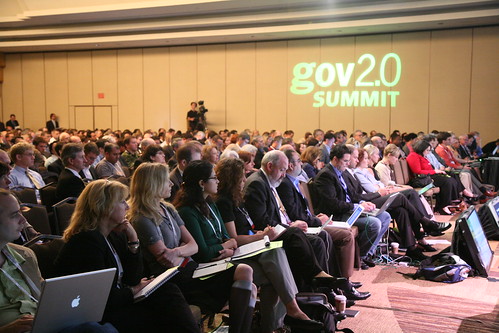
Image Courtesy of Flickr User Alex Dunne

Image Courtesy of Flickr User Alex Dunne

We’ve already had the Summer of Gov, but September 7-11 was the Week of Gov.  With the Gov 2.0 Expo Showcase on Tuesday and the Gov 2.0 Summit on Wednesday and Thursday, plus a multitude of happy hours and networking receptions, I was immersed in all things Gov 2.0 last week.  There are already plenty of recaps, summaries, and other articles detailing the events of last week – if you’re interested in finding out what you missed, videos from all of the sessions are (or will soon be) posted here.  Watch those, and then read through all of the news coverage here for that.  Now, what I want to explore in this post is one particular topic that came up time and time again among the attendees I spoke with.

There were some very successful, very cool Gov 2.0 initiatives that were highlighted, but while I came away both impressed and inspired by the results that were discussed, I was left asking myself more and more questions about HOW the speakers got to these results.  This isn’t a criticism of these two events – I realize that I wasn’t the target audience for the Summit (that program was geared more toward C-level execs) and the Showcase was more of a teaser for the Gov 2.0 Expo coming up in May.  That’s exactly why I now have more questions than answers – I want to know about the challenges these people faced; I want to know the risks they took and why; I want to know what they’d do differently if they could go back in time – most of all, I want to know how they went from good idea to being highlighted at the Gov 2.0 Expo Showcase or Gov 2.0 Summit.

As my colleague Brian Drake discussed in this blog post, we both spoke with a number of people who would like to see a  Gov 2.0 Practitioner event that targets the people actually doing the work of Government 2.0.  While it’s great to hear from people like Vivek Kundra and Vint Cerf, it’s difficult for me to relate directly to their experiences or to turn that knowledge into something actionable in my day-to-day job.  A Gov 2.0 Practitioner conference that focuses on the real-life challenges, benefits, and concrete actions would help fill this gap, giving attendees a action plan for moving forward.  So while I left the Gov 2.0 Summit feeling excited about the prospects of OpenID and Government 2.0, I was also left asking myself things like, “that’s great that OpenID is coming to the government, but now what?  How do I help my client’s organization take advantage of this program?  How do I turn this great idea into something actionable for my client?”

I think there’s a very real need for an event that brings together Gov 2.0 practitioners and aspiring practitioners in one place to share war stories, to discuss what really works and what doesn’t, and to learn from each others’ mistakes and successes.  Maybe it’s another Gov 2.0 Barcamp or another event entirely, but I don’t need another event to discover the benefits of opening up my data or by communicating more transparently.  What I need is an event that tells me how I get my manager to sign off on dedicating the resources needed to make that data open and accessible. I need an event that answers these questions  (and more):

  • How do I negotiate with my IT staff to get social media sites unblocked?
  • How do I involve our Legal department when I’m terrified they’re going to shut me down?
  • What’s the best way to get people to contribute to our organizational wiki?
  • What am I missing in my social media policy?
  • How do I best get senior leadership to actively participate in social media?  Should they?
  • We still have Internet Explorer 6 – how am I supposed to get IT to support social media?
  • We have a blog, Twitter account, podcasts, and other social media already, but no one is using them – what’s the best way to build more community?
  • We have a TON of data that I want to open up to the public, but I don’t own any of it – how do I approach the owners of this data and convince them to open it up?

Would you be interested in an event dedicated to sharing these types of war stories and providing actionable next steps that you could use?  If you’ve ever left a Gov 2.0 conference and had any of these questions, then you’re the target audience!

Continue reading...

What Does Government 2.0 Mean to Me?

Because Booz Allen is a Diamond Sponsor of next week’s Gov 2.0 Summit, and I’m on the Program Committee for the Gov 2.0 Expo Showcase, I have been incredibly busy trying to pull together presentations, talking points, attendee lists, and other logistics for next week.  However, I did take some time to participate in Tim O’Reilly’s “What Does Gov 2.0 Mean to You?” initiative in advance of the Summit next week.  For me, Government 2.0 isn’t about the tools, but what those tools enable – it’s about more than just creating a blog and engaging in dialogue with the public, it’s about more than just creating a wiki that’s open to multiple government agencies, and it’s about more than just making data accessible to the public.  Gov 2.0 is about what you do after that.  It’s about updating policies because of the conversations you had on the blog, it’s about using a wiki to deliver better intelligence analysis to our country’s decision makers, and it’s about opening up government data to crowdsource IT development, saving money increasing innovation.

There are tons of GREAT initiatives out there, initiatives that we’ll learn more about next week, but in many cases, these initiatives are just laying the foundation for government innovation. Think about it.  Next week, we will hear about lots of exciting Gov 2.0 initiatives taking place at the federal, state, and local levels. But, we’re also going to hear lots of stories about social media bans, offices still using IE 6, and information silos.  Remember that Government 2.0 isn’t just about getting on Twitter or building a wiki – those are just first steps.  It’s about using these tools to create a government that’s truly of the people, by the people, and for the people.

Continue reading...

The Evolution of the Social Media Evangelist

Do the EvolutionI’m currently going through my annual assessment, and in completing my self-assessment, I had some time to reflect on the last year and subsequently, over my six years at Booz Allen. As I combed through old emails and files, I thought back to 2006 when I first realized that social media was a game-changer in the government space. I remembered all the briefings I did, all the emails I sent, all the debates I had with people, and that’s when I realized the evolution that had taken place over the last three years. While I can say that being a social media evangelist has hasn’t always been easy or fun, it’s always moved forward – sometimes more slowly than other times, but always forward.

Since that first day back in 2006, when I realized the opportunities that social media presented me, my company, and my government, I have evolved from an opportunist to a leader (I hope!), and I can only hope that I’ll continue to evolve in the years ahead. Here are the seven evolutionary stages that I went through as a social media evangelist – I’m interested in hearing if you find yourself going through a similar evolution, or if you skipped a few steps and went straight from an amoeba to advanced human 🙂

Phase One – The Opportunist

In the first phase, you are an Opportunist. In this initial phase, you’ve identified an opportunity – this can be for you, for your team, your division, or your organization. You start by doing exhaustive research to see if this opportunity is feasible and realistic. Your ambitions run wild as you focus on all of the raises, promotions, and accolades that are potentially available if you are able to take advantage of this opportunity. In my case, this is the stage where I first read books like the Cluetrain Manifesto and Wikinomics and when I first started using Intellipedia. I started talking with my mentors about social media and why it represented a huge opportunity for improving communication and collaboration internally and with our clients.  At this point, ideas of all kinds are running through your head, but they’re primarily driven by personal gain – I will be able to save time, work more efficiently, make more money, win an award, etc.

Phase Two – The Idealist

The next stage is the idealistic stage.  This is where you start adding outcomes to the ideas you’ve come up with. You start thinking things like, “If the intelligence community can collaborate on a wiki, then why isn’t every organization?  If only I could show them what we could do with a wiki, there’s no way they could turn that down!”  While in the Idealist stage, you don’t consider real-world issues like firewalls, policies, changes in administration, funding, or internal politics. You are going to change the world with this wonderful idea or product of yours and the masses will ask, “why didn’t I think of that?” You work almost solely in the land of potential and while this passion for social media starts flowing into all aspects of your work, you start to realize that passion and potential alone isn’t going to cut it.

Phase Three – The Pessimist

Quickly following the highs of the Idealist stage come the lows of the Pessimist stage. This is where you will most likely be brought back to earth by the policies, management, and politics of the real world.  You will be called naive. You will be told by people being paid much more than you that your idea can’t be done. Seemingly, everyone you talk with have a reason why your idea or dream can’t be accomplished. They will tell you things like, “we’ve never worked like that before” and “there’s no way that will work because of the policy.”  You will start to question if you made the right decision to pursue these ideas, if you’ve wasted your time going down some rabbit-hole that you’ll never be able to get out of.  You will get incredibly frustrated as you give what seems like the 100th briefing on what social media is, what it isn’t, and how it can help, and then see no tangible movement follow. You’re left wondering, “what’s wrong with everyone – this seems so obvious to me, and I just don’t get why they don’t recognize it too!!”

Phase Four – The Workaholic

In the Workaholic phase, you’re working 9-5 on your “real” job, and then 5-9 on your idea, your passion.  You’ve gained a critical mass of supporters and people have started to recognize you as the primary resource on social media. You’re fielding dozens of questions every day about what social media is and why it can be beneficial. If available, you’re one of the most active bloggers or wiki editors. If not officially yet, you’re functioning as the de facto community manager for the social media tool that you’ve inevitably already started. You’re trying to get others as excited as you are by being extra active – commenting on every blog, giving briefings to anyone who will listen, sending out emails to articles extolling the virtues of social media.  You’re suffering from both the Hatred of Losing Information (HOLI) and the Fear of Missing Out (FOMO).  This is the stage that I found myself in for the longest period of time, and I think it’s because I was focused on bringing social media to a 22,000+ person organization.  For smaller orgs, I’m guessing this phase is much shorter.

Phase Five – The Egotist

The Egotist phase sometimes overlaps with the Workaholic stage. This is where you get an overinflated sense of ego and might start calling referring to yourself as a social media expert or guru. You’ve now got more supporters than detractors. You’ve probably won a few awards and might have even gotten a raise or a promotion, due largely to your social media evangelizing efforts. In the Egotist stage, you start feeling a strong sense of ownership over all things social media, and think you have more control and authority than you do. You may even start arguing with people, saying, “you’re not doing it right!” The Egotist can be a very nasty stage, one that ends up actually inhibiting your overall goals. When I reached this stage, I was lucky because I had surrounded myself with lots of very smart, honest people who called me on it, and explained that I couldn’t control everything related to social media in an organization as big as Booz Allen. I learned that I could no longer be involved with every single social media-related effort – I had to become a teacher.

Phase Six – The Teacher

The Teacher phase is one born out of necessity. At some point, the desire for social media knowledge and expertise within your organization is going to grow so large and so widespread that it will be impossible for you to manage it all. You will no longer be able to keep up with the entire community’s activities. You won’t be able to fulfill every request for a briefing. You’ll need to teach others the same philosophies and methods that you’ve learned. You’ll have to help them determine how to navigate the political and administrative barriers that you’ve had to negotiate to get where you are now. This is the most critical phase, the phase that will determine if your social media efforts blossom into a scalable, organizational-wide effort, or just looked at as a proof of concept with potential.

Phase Seven – The Leader

The final phase (at least thus far) is the Leader phase. At this stage, you’ve formed your team and you’ve learned what you need to get involved with and what you can entrust to others. You’re not only managing the work of others, but you’re leading them as well. All your work to this point has set you up to be a leader of social media, not just an evangelist.  People respect and seek out your opinion, not because they have to, but because they think you have something to add. You’ve taken the “let a thousand flowers bloom” approach now and have totally reversed position on other social media leaders in the organization. You no longer feel threatened as you did in the Egotist phase. Rather, you now feel proud to see other people throughout the organization start to realize the value that social media can have. You officially transitioned from a grass-roots initiative to an accepted, respected, and valued service offering, capability, or culture.

So what’s the next phase?  I’m not real sure at this point. I think that I’m currently transitioning from the Teacher phase to the Leader phase, but I’m not entirely sure what’s next. My hope is that social media will just become so ingrained in people’s lives that it will be time for a new evolution to take place, an evolution that uses social media to help further an even greater cause.  Maybe that’s when you enter the “Mentor” phase…

Continue reading...

Social Media and the Next Generation

My four years at Bethany College will always stick in my mind as some of the best times of my life.  Professionally, this is where I learned the fundamentals of communications, from public relations to advertising to writing for the media. Personally, this is where I formed many of the relationships that have made me the person that I am today.  This period of professional and personal growth has had a tremendous impact on everything that I do and I’m extraordinarily grateful for the relationships, experiences, and knowledge that I gained while I was in college.  It was here that I first learned the differences in writing a feature story and a news story, where I learned how to give a public presentation, where I first experienced what it was like to work with an actual client, where I began to understand that all the knowledge in the world isn’t going to cut it in the “real world” unless I had people skills too.  Disappointingly though, I didn’t learn a single thing about social media, Web 2.0, and especially not Government 2.0.  It wasn’t just that this terminology didn’t exist, it was that the principles of methods of open, transparent communications didn’t exist either.

We had a “Mass Communications 101” class where we learned how broadcast, communications had evolved over the years.  We had a “Communication Theory” class where we learned the Magic Bullet theory and the Mean World theory.  But, we never had a class where we learned the many-to-many communications model of social media.  We never had a class where we discussed the differences in writing for a blog versus writing for a newspaper.  Media relations 101 didn’t even mention bloggers.  We were learning communications for the past and the present but were unprepared for communications in the future.  How would communications evolve over time?  What new tools would change the way organizations communicated?  What new communications methodologies would be embraced?

Since I graduated, I’ve spoken to many students, professors, and alumni, and I’ve been consistently disappointed in the lack of formal (or informal) education around social media at the collegiate level.  Despite what you may have heard from the Baby Boomer generation, today’s college students aren’t out there creating blogs, tweeting, or using wikis on a regular basis.  Sure, they are most likely on Facebook or MySpace for personal reasons, but using Facebook to organize your next Edward Forty-hands mixer is a lot different than using a blog to change public opinion and organize an online community.  I’ve met just as many 24-year-olds who are as completely befuddled by Twitter as 42-year-olds.

Enter the Social Media Club Education Connection.  Ever since I started working as a consultant at Booz Allen, I’ve loved mentoring my colleagues, giving presentations at college campuses, and coaching junior team members on projects.  I’ve always gotten a lot of satisfaction from helping others reach their potential while still showing them that they can have fun doing it too. For these reasons, I’ve also been very interested in the opportunities for improvement in higher education and communications. Then one day in April, while attending the SNCR New Communications Forum, surrounded by people like Shel Israel, Chris Brogan, Geoff Livingston, Jeremiah Owyang, Katie Paine, and many other luminaries in the social media community, I thought to myself, “This is EXACTLY the type of conference that a college student should be attending.”  Further inspired by the next generation of social media leaders – people like Dana Lewis, Sydney Owen, and Dena Olyaie, and professors like Mihaela Vorvoreanu and Howard Rheingold – I tweeted that I thought there should be collegiate chapters of Social Media Club.  Shortly thereafter, I had a lengthy conversation with Chris Heuer, founder of the Social Media Club, about how to turn this idea into action and formally establish something.

Just a few months later, we’ve officially established the Social Media Education Connection (almost 150 members deep already!). I’m extremely excited to start working with George Washington University, one of our founding #SMCEDU chapters, right here in Washington DC.  In cooperation with student representatives, Dena Olyaie and Cathryn Sitterding, and faculty representative, Sean Aday, I’m looking forward to cultivating the relationship between the students of George Washington University, the DC Chapter of Social Media Club, and Booz Allen Hamilton.  When I first talked with Chris about establishing the Social Media Club Education Connection, we discussed our goals for this new initiative:

  • Connect the local Social Media Club groups more closely with their local universities
  • Co-create a combination of mentoring programs, internships, professional development opportunities to benefit both the university and professional chapters
  • Co-create a repository of Creative Commons licensed Social Media curriculum

Over the coming months, I will be working with Dena and Cathryn to create an SMCEDU GW chapter charter, work with the university to become an officially recognized organization, secure meeting space, identify additional interested students, create a strategic plan, and work with the SMCDC chapter leadership to identify professional development opportunities.  I hope this is the start of something much bigger, something that will spread throughout colleges and universities across the country, and I hope that you’ll be a part of it too.

Who knows what social media will be like in 5 or 10 years?  Who will be tomorrow’s communications leaders?  You now have the opportunity to help shape the future of the communications industry by helping shape the careers of the next generation. If you want to be part of the effort to improve the quality of social media education being offered in schools, please join our new SMCEDU Project Community on Ning.

*Image courtesy of Flickr user CLF*

Continue reading...